Running a nail salon looks simple from the outside. A few chairs, polish on display, steady music, and clients walking out with fresh sets. But behind the scenes, it’s a constant juggle—appointments, walk-ins, staff schedules, inventory, payments, and the occasional “Can you squeeze me in right now?” moment.
That’s where nail salon management software quietly steps in. Not as some flashy upgrade, but as something that can either make your day smoother—or frustrate you even more if it’s not the right fit.
Let’s get into what actually matters when you’re choosing and using one.
The Daily Chaos It’s Meant to Fix
If you’ve ever double-booked a technician by accident, you already understand the problem.
Picture this: it’s a Saturday afternoon. You’ve got a full house. One client shows up early, another is late, and someone calls asking for a last-minute gel refill. Meanwhile, your front desk is flipping between a paper notebook and a payment terminal that doesn’t quite sync with anything else.
This is exactly the kind of mess salon software is supposed to untangle.
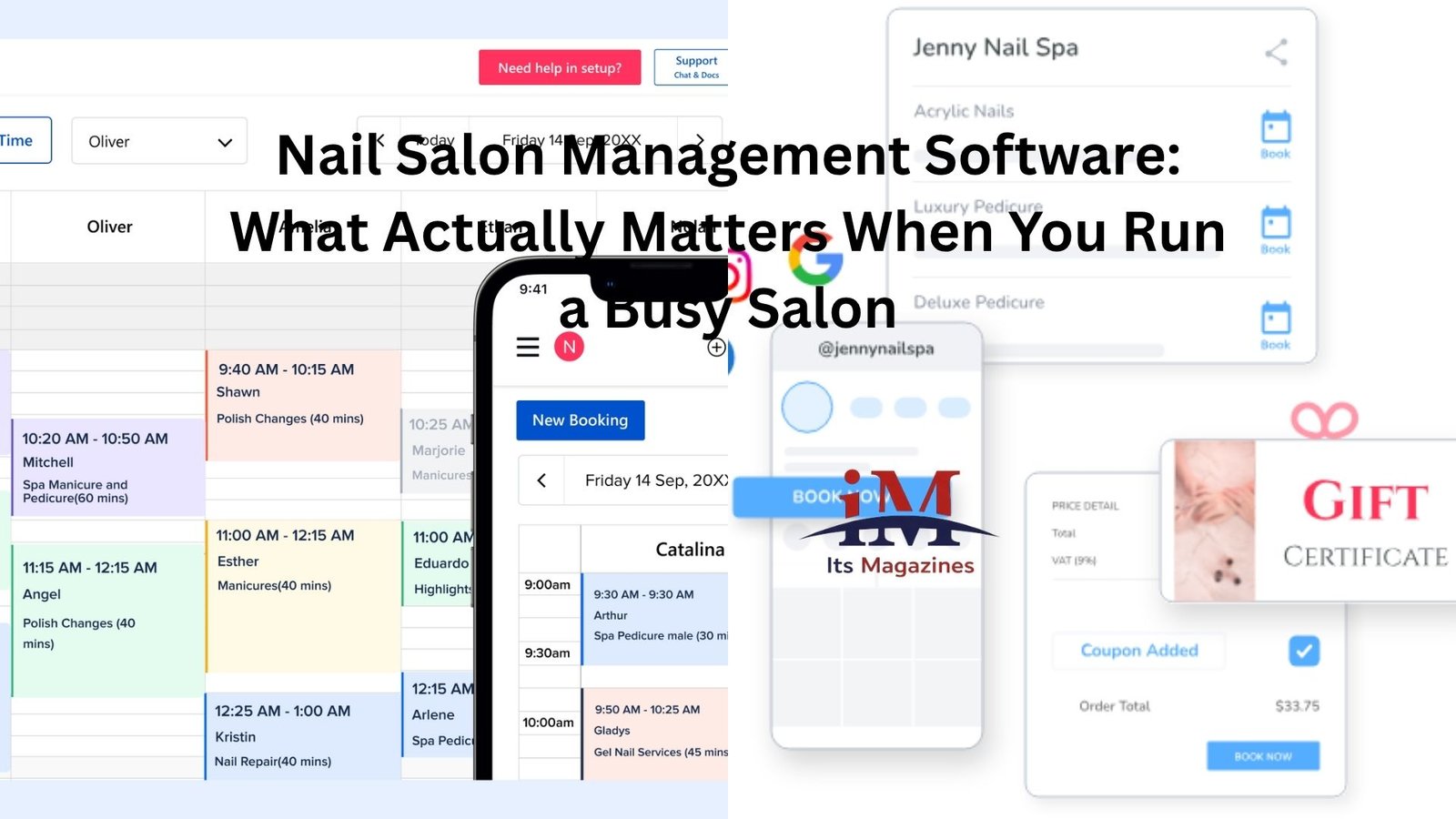
A good system pulls your bookings, staff availability, and services into one place. Not in a complicated way—just clearly enough that you can glance at a screen and know what’s happening.
And honestly, that clarity alone can lower stress more than people expect.
Booking Should Feel Effortless (For You and Your Clients)
Here’s the thing—clients don’t want to call anymore unless they have to. They want to book at midnight while lying in bed, or during a quick break at work.
If your system doesn’t support online booking, you’re probably missing appointments. Not because people don’t like your salon, but because they move on when it’s inconvenient.
But it’s not just about having online booking. It needs to be clean and intuitive.
No one wants to click through five screens just to pick a manicure.
From your side, the setup matters just as much. Services should be easy to adjust. Time slots should reflect reality. If a nail art session takes longer than a basic polish, your system shouldn’t treat them the same.
Small detail, big difference.
Staff Scheduling Without the Headaches
Managing a team in a salon isn’t just about filling shifts. It’s about matching the right technician to the right service, keeping workloads balanced, and avoiding burnout.
A decent system helps you see who’s available, who’s overbooked, and where you have gaps.
But here’s where some software gets it wrong—it becomes too rigid.
Real life doesn’t follow a perfect schedule. Someone calls in sick. Someone wants to swap shifts. A regular client insists on seeing a specific technician.
The software should bend with you, not force you into awkward workarounds.
One salon owner I spoke to said she still kept a sticky note system alongside her software “just in case.” That’s usually a sign something isn’t working as well as it should.
Payments, Tips, and the Awkward Moments
Let’s be honest—checkout can get uncomfortable.
Clients splitting payments. Adding tips after the fact. Asking for receipts. It can slow things down, especially when there’s a line forming.
A solid management system ties payments directly to appointments. No guessing who paid for what. No chasing down missing transactions at the end of the day.
Even better when tips are built in and easy to add. It sounds minor, but technicians notice when tipping becomes smoother. It often leads to better overall earnings—and happier staff.
And when everything’s recorded properly, your end-of-day closing becomes a lot less painful.
Inventory: The Part Everyone Ignores (Until It’s a Problem)
You don’t think about inventory much—until you run out of a popular color in the middle of a fully booked day.
Then suddenly it’s all you can think about.
Management software can track product usage, alert you when stock is low, and even suggest reorders. But here’s the catch: it only works if you actually use it consistently.
A lot of salons skip this part because it feels tedious. And to be fair, some systems make it harder than it needs to be.
The better ones keep it simple. You log what you use, and the system does the rest in the background.
It’s not exciting. But it prevents those small disruptions that chip away at your day.
Client History Is More Powerful Than It Sounds
At first glance, client profiles seem like a nice extra. Names, phone numbers, maybe a note or two.
But when used properly, they become one of the most valuable tools you have.
Imagine a client walks in and you can instantly see:
- The last service they booked
- The color they chose
- Any allergies or preferences
- How often they typically visit
That changes the conversation.
Instead of asking the same questions every time, you’re picking up where you left off. It feels more personal without requiring extra effort.
Clients notice that. They might not say it directly, but it’s the kind of detail that builds loyalty.
Reports That Actually Help You Make Decisions
Most salon owners don’t wake up excited to check reports. But the right data can quietly shape better decisions.
You start to see patterns.
Which services are most popular. Which days are slow. Which technicians are fully booked weeks in advance.
Without that visibility, you’re guessing.
With it, you can adjust pricing, run promotions at the right time, or tweak your schedule to match demand.
That said, not all reporting is useful. Some systems drown you in charts that don’t mean much.
The goal isn’t more data—it’s clearer insight.
Where Some Software Falls Short
Not everything labeled “nail salon management software” is actually built with nail salons in mind.
Some tools feel like they were designed for general appointments and then lightly adapted.
That’s when you run into annoyances like:
- Services that don’t reflect real salon workflows
- Limited options for add-ons like nail art or repairs
- Awkward timing setups
- Clunky interfaces that slow down your front desk
And when you’re busy, even small inefficiencies feel bigger.
There’s also the issue of overcomplication. Some platforms try to do everything—marketing, payroll, CRM, inventory, analytics—and end up being overwhelming.
More features don’t automatically mean better.
The Balance Between Simple and Capable
Here’s what most salon owners actually need: something that handles the essentials well, without getting in the way.
You want to open your system and immediately understand your day.
You want to make changes quickly.
You want your staff to learn it without needing a full training session.
That balance—simple but capable—is harder to find than it sounds.
Some systems lean too basic and lack flexibility. Others are so feature-heavy they become frustrating.
The sweet spot is where the software feels like a natural extension of how your salon already works.
Real-Life Shift: What Changes After You Get It Right
When a salon finally finds a system that fits, the difference isn’t dramatic overnight—but it’s noticeable.
The front desk feels calmer.
There are fewer booking mistakes.
Staff stop asking as many scheduling questions.
Clients book more easily, show up more consistently, and spend less time waiting.
It’s not that problems disappear. It’s that fewer small things pile up into bigger ones.
One owner described it as “having more mental space.” That’s probably the best way to put it.
Choosing Without Overthinking It
It’s easy to get stuck comparing features, pricing tiers, and reviews.
But at some point, you have to bring it back to your actual day-to-day needs.
Ask yourself:
- Does this match how my salon operates?
- Can my team use it without frustration?
- Will it save me time where it actually matters?
A free trial usually tells you more than any feature list ever will.
Click around. Try to book appointments. Pretend it’s a busy day and see how it feels.
You’ll know pretty quickly if something’s off.
The Quiet Role It Plays in Growth
Salon growth doesn’t always come from big changes. Sometimes it comes from removing friction.
When bookings are smoother, clients return more often.
When staff schedules are balanced, your team stays longer.
When you understand your numbers, you make better decisions.
Nail salon management software sits in the background of all of that. It’s not the star of the show—but it supports everything else.
And when it’s working well, you barely notice it.
Which is exactly the point.
Final Thoughts
Running a nail salon is already demanding. You don’t need tools that make it harder.
The right management software won’t transform your business overnight, but it will quietly make your days more manageable, your team more organized, and your clients better served.
And over time, those small improvements add up in a big way.
If you’re constantly putting out little fires—missed bookings, scheduling mix-ups, inventory surprises—it might not be your system. It might be the lack of one that truly fits how you work.
That’s worth paying attention to.