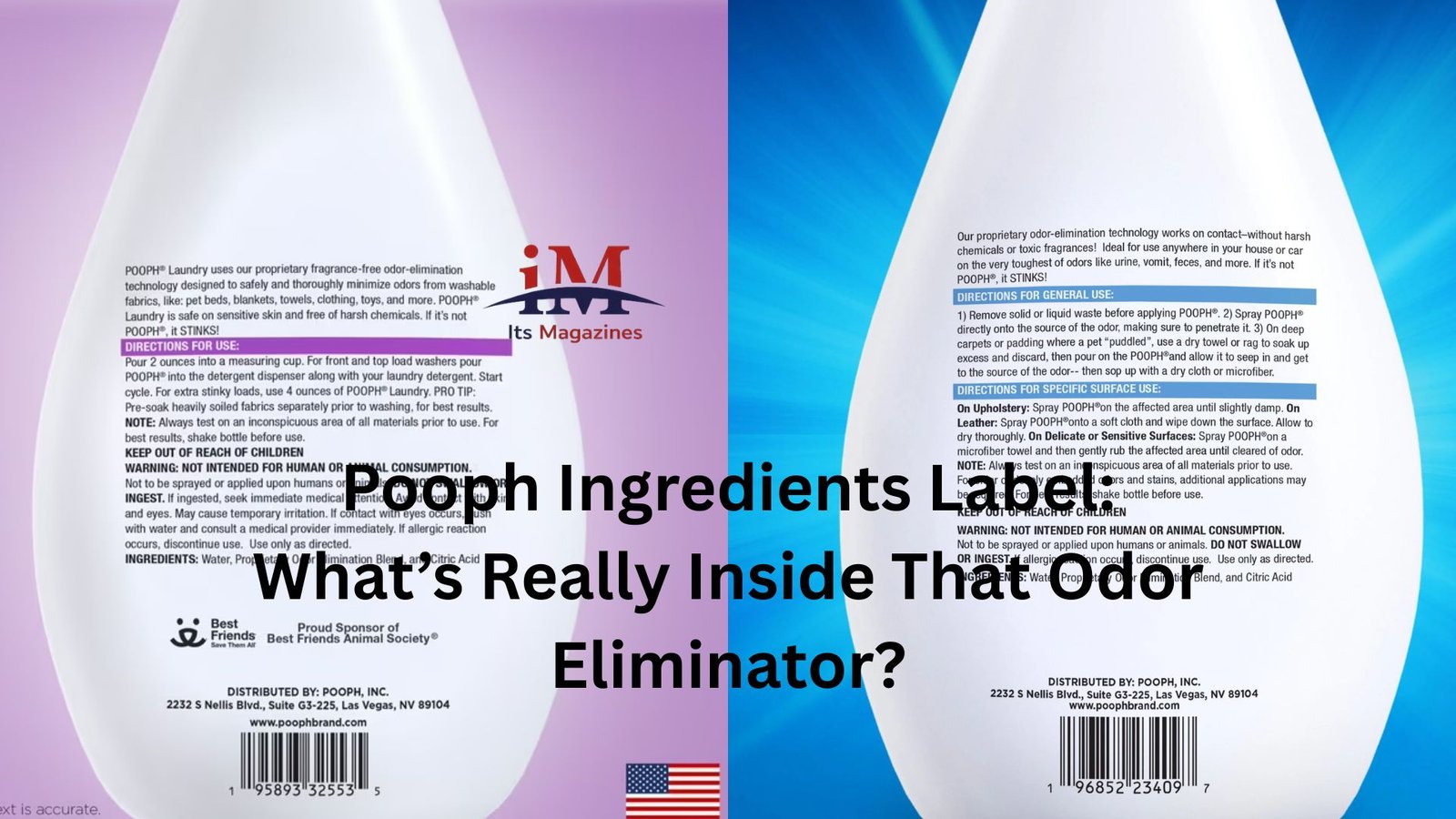
You spray something, the smell disappears, and you move on with your day. Simple enough. But if you’ve ever flipped over a bottle of Pooph and tried to decode the ingredients label, you might’ve paused. It doesn’t read like your typical cleaner. No long list of chemicals you can’t pronounce. No obvious red flags either. Just… minimal.
So what’s actually going on here?
Let’s take a closer look at the Pooph ingredients label and what it really means in everyday terms.
The First Thing You Notice: It’s Almost Too Simple
Pick up a typical household cleaner and you’ll see a paragraph of ingredients. Pooph doesn’t do that. Its label is surprisingly short. Almost suspiciously short, depending on how used you are to complicated formulas.
That simplicity is intentional.
The product is marketed as non-toxic, odorless, and safe to use around pets and people. So instead of layering fragrances on top of smells—which is what a lot of sprays do—it claims to eliminate odors at a molecular level.
That sounds like marketing talk, but the ingredient list gives a clue as to how it works.
What the Label Actually Lists
At its core, Pooph’s ingredients label typically mentions:
- Water
- A proprietary blend of minerals
That’s it. No dyes. No perfumes. No alcohol.
Now, “proprietary blend” is where people raise an eyebrow. It’s vague by design. Companies use that phrase when they don’t want to disclose exact formulations. That doesn’t automatically mean anything shady—but it does mean you won’t get a full breakdown.
Here’s the thing though: many everyday products do the same. Even “natural” brands often protect their formulas this way.
The real question is whether the ingredients behave in a way that matches the claims.
So… Does It Actually Do Anything?
Let’s be honest. If you just read “water and minerals,” you might assume it’s basically fancy tap water.
But the effectiveness comes from how those minerals are processed.
From what’s publicly described, Pooph uses a type of oxidizing reaction. That means it doesn’t mask odors—it breaks down the molecules causing them. Think of it like neutralizing the smell instead of covering it up.
Imagine this scenario. Your dog has an accident on the carpet. You clean it, but there’s still that lingering scent. A typical spray might make the room smell like “lavender accident.” Pooph aims to remove the odor entirely, leaving… nothing.
No fragrance. No chemical after-smell. Just neutral air.
That’s the idea, anyway.
Why There’s No Fragrance
This part surprises people the most.
We’ve been trained to associate “clean” with a scent. Citrus, pine, something fresh. When a product doesn’t smell like anything, it can feel like it’s not working.
Pooph flips that expectation.
The absence of fragrance isn’t a missing feature—it’s the point. By not adding scent, it avoids triggering sensitivities and doesn’t mix smells in weird ways.
If you’ve ever used a heavily scented cleaner in a small room, you know how quickly that can get overwhelming. Especially with pets or kids around.
So the lack of fragrance actually lines up with the ingredient philosophy: keep it simple, keep it safe.
Is “Mineral-Based” Actually Safer?
Now we get into the part that people really care about.
When something says “mineral-based,” it sounds reassuring. But it’s worth unpacking what that means.
Minerals are naturally occurring substances. That doesn’t automatically make them safe in every form, but it’s generally a good starting point. In Pooph’s case, the formulation is designed to be non-toxic and non-irritating.
The product is often described as safe for use around pets, including birds—which is a big deal, since birds are extremely sensitive to airborne chemicals.
That said, “safe” doesn’t mean you should go spraying it directly into your eyes or drinking it. Common sense still applies.
But compared to harsh chemical cleaners, it’s definitely positioned on the gentler end of the spectrum.
Real-Life Use: Where It Actually Makes Sense
This is where the ingredients label meets reality.
Pooph tends to show up in homes with pets. Dogs, cats, sometimes even litter boxes that have seen better days.
Picture this: you’ve got guests coming over, and your dog decides today is the day to roll in something questionable outside. You clean them up, but the smell lingers in the room. A quick spray, and instead of layering perfume on top of it, the odor just… disappears.
That’s where the product shines.
It’s also useful for things like:
- Trash cans that smell no matter how often you empty them
- Couches that have absorbed years of life
- Shoes that have been through one too many summers
In these situations, a heavy chemical cleaner can feel like overkill. Something lighter—but still effective—makes more sense.
The Trade-Off: Transparency vs Simplicity
Let’s address the elephant in the room.
The ingredient list is short, but it’s not fully transparent. “Proprietary blend” leaves questions unanswered.
If you’re someone who likes to know every single component in a product, that might bother you. And that’s fair.
On the other hand, the simplicity of the label and the lack of known harsh chemicals make it appealing to people who just want something that works without introducing a bunch of extra stuff into their home.
It comes down to what you prioritize.
Total transparency? Or a minimalist approach that leans on trust and performance?
How It Compares to Traditional Odor Eliminators
Most odor eliminators fall into one of two camps.
The first masks smells with strong fragrances. Think air fresheners. They’re quick, but temporary. And sometimes they make things worse.
The second uses enzymes or chemicals to break down odors. These can be effective but often come with strong smells or potential irritation.
Pooph sits somewhere in the middle.
It aims to neutralize odors without enzymes or heavy chemicals, and without adding fragrance. That’s a pretty narrow lane, and not many products operate there.
Whether it’s better depends on what you’re dealing with.
For deep, set-in stains, you might still need a stronger cleaner. But for everyday odor control, this lighter approach can be enough.
A Quick Reality Check
No product is magic. And it’s worth saying that out loud.
If there’s a serious underlying issue—like mold, deeply soaked upholstery, or poor ventilation—no spray is going to solve it completely.
Pooph works best as a surface-level odor eliminator. It handles smells that are present but not permanently embedded.
Think of it as a maintenance tool, not a total fix for bigger problems.
Why People Keep Talking About It
A lot of the buzz around Pooph comes down to expectations.
People try it expecting another scented spray. When it behaves differently—no smell, no residue—it stands out.
Some love that. Others aren’t convinced at first because there’s no sensory “proof” like a strong scent.
But over time, the absence of odor becomes the proof.
It’s a subtle shift, but once you notice it, it’s hard to go back to heavily perfumed cleaners.
Final Thoughts: What the Label Tells You (and What It Doesn’t)
The Pooph ingredients label is intentionally simple. Water and a proprietary mineral blend don’t tell the whole story, but they point in a clear direction: minimalism, safety, and odor neutralization rather than masking.
It’s not the most transparent product on the shelf, but it’s also not trying to overwhelm you with complexity.
If you want a straightforward odor eliminator that doesn’t fill your home with artificial scents, it makes sense. If you prefer full ingredient disclosure, you might hesitate.
Either way, the label reflects the product’s core idea: less noise, more function.
And sometimes, that’s exactly what you need.