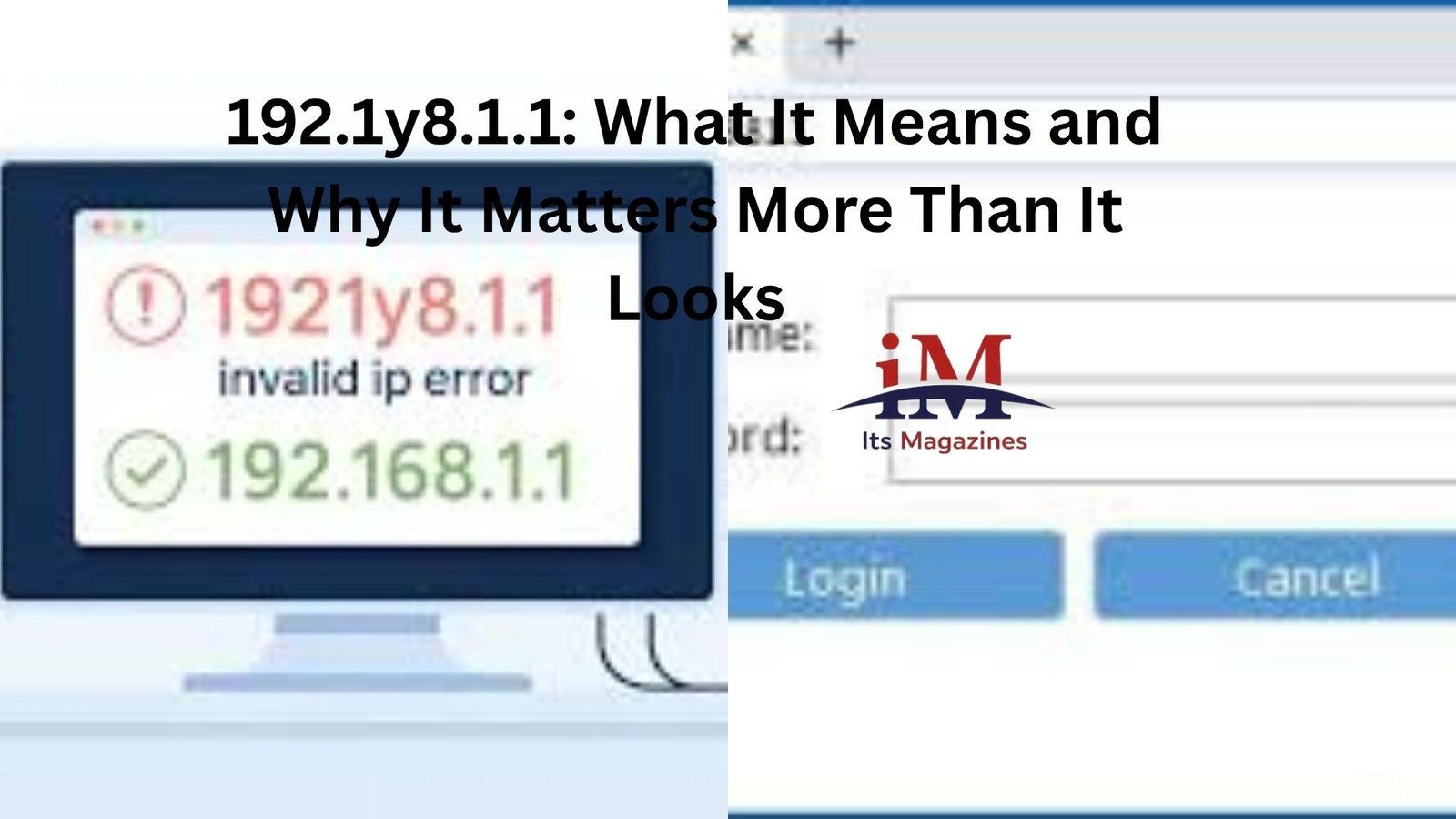
At first glance, “192.1y8.1.1” looks like a typo. Something you’d get if your fingers slipped while typing a familiar IP address. But here’s the thing. Strings like this show up more often than you’d expect, especially in logs, error messages, and odd corners of the internet where things aren’t always clean or predictable.
So instead of brushing it off, it’s worth slowing down and asking a simple question: what’s really going on here?
Because behind something that looks meaningless, there’s usually a story. And if you deal with networks, security, or even just basic troubleshooting, that story can matter.
When Something Looks Like an IP… But Isn’t
Most people recognize something like 192.168.1.1. It’s the default gateway for a lot of home routers. Clean, structured, predictable.
Now compare that to 192.1y8.1.1.
It almost follows the same pattern. Four sections, separated by dots. But that “y” breaks everything. Suddenly it’s no longer a valid IPv4 address. It’s just a string.
That small difference changes how systems treat it.
A browser won’t route to it the same way. A DNS resolver won’t interpret it cleanly. A firewall might log it differently. Some tools might reject it outright. Others might try to “fix” it.
And that’s where things get interesting.
The Quiet Role of Invalid Inputs
Let’s be honest. Most systems expect clean input. Numbers where numbers belong. Letters where letters belong.
But real-world data is messy.
Someone mistypes an address. A script concatenates strings incorrectly. A log captures partial data. Suddenly you’ve got entries like 192.1y8.1.1 floating around.
Here’s a small example.
Imagine a junior admin trying to SSH into a server. They type quickly:
ssh user@192.1y8.1.1
The command fails. They assume the server is down. They spend 20 minutes checking cables, restarting services, maybe even messaging teammates.
All because of one stray character.
That’s not rare. It happens all the time.
Why Systems React Differently
Not all software handles invalid input the same way.
Some tools are strict. They see “192.1y8.1.1” and immediately throw an error. No ambiguity.
Others are more forgiving. They might strip out invalid characters. Or try to interpret what the user “meant.”
That flexibility can be helpful. But it can also introduce subtle bugs.
For instance, a logging system might store the string as-is. Later, a parser expects a valid IP. It fails silently. Data gets skipped. Reports become incomplete.
Now multiply that across thousands of entries.
You don’t notice it right away. But over time, the cracks show.
The Security Angle Most People Miss
Here’s where things shift from annoying to potentially serious.
Invalid or malformed inputs are a common entry point for security issues.
Not because “192.1y8.1.1” is dangerous on its own. But because it tests how your system behaves under unexpected conditions.
Think about input validation.
If a system expects an IP address but doesn’t properly validate it, attackers can exploit that gap. They might inject unusual characters. Break parsing logic. Bypass filters.
Now, this exact string isn’t an attack. But it lives in the same category of “things that shouldn’t happen but do.”
And those are the things worth paying attention to.
Real-Life Scenario: Log Confusion
Picture this.
You’re reviewing access logs after a minor incident. Most entries look normal. Then you spot something odd:
Failed login from 192.1y8.1.1
You pause.
Is it a real IP? A corrupted entry? A sign of probing?
You dig deeper. Turns out it was a malformed request from a bot. Not harmful this time. But it reveals something: your system logged it without filtering.
Now imagine if that same system feeds into an automated alert system. Or a dashboard.
You might get false positives. Or worse, miss real issues because the data isn’t clean.
Human Error Is Always in the Loop
It’s easy to assume everything weird comes from machines. But humans are often the source.
Typing fast. Copy-pasting carelessly. Editing configs at 2 a.m.
That’s how strings like 192.1y8.1.1 are born.
Here’s a simple example.
Someone copies an IP from a document where the font makes “8” and “B” look similar. They paste it into a config file. No validation happens. The system behaves strangely.
They spend hours debugging something that shouldn’t have been a problem.
We’ve all been there in some form.
Why Validation Isn’t Just a “Nice to Have”
Good systems don’t assume perfect input. They check it.
Strict validation might feel annoying at first. It stops you when you make a mistake. But that’s the point.
It’s like a spellchecker that actually catches the error before you send the message.
Without validation, bad data spreads.
It moves from input to storage, from storage to analysis, from analysis to decisions.
By the time you notice, it’s everywhere.
The Subtle Cost of Ignoring Small Errors
One malformed string doesn’t break a system.
But hundreds? Thousands?
Now you’re dealing with noise.
Metrics become less reliable. Alerts trigger at the wrong times. Debugging takes longer because the data isn’t trustworthy.
It’s like trying to read a book with random letters inserted into words. You can still understand it, but it slows you down.
And in technical environments, that slowdown adds up quickly.
Cleaning Up the Mess
So what do you do when you encounter something like 192.1y8.1.1?
First, don’t ignore it.
Ask where it came from.
Was it user input? A script? An external request?
Then check how your system handled it.
Did it reject it? Log it? Try to interpret it?
From there, you can decide what needs tightening.
Maybe you add stricter validation rules. Maybe you improve error messages so users immediately know what went wrong.
Sometimes the fix is small. A simple regex check. A clearer prompt.
But the impact is bigger than it seems.
A Quick Thought on Developer Mindset
There’s a habit among experienced developers and admins. They pay attention to the weird stuff.
Not obsessively. Just enough to notice patterns.
Because those odd strings, unexpected values, and edge cases often reveal deeper issues.
192.1y8.1.1 isn’t important by itself.
But it’s a signal.
It tells you your system encountered something outside the norm. And how it reacted to that tells you a lot about its robustness.
When Flexibility Helps—and When It Hurts
Some systems try to be helpful. They auto-correct inputs.
For example, a tool might strip out the “y” and interpret the address as 192.18.1.1.
That sounds convenient.
Until it isn’t.
Now you’re connecting to the wrong machine. Or logging data under the wrong identifier.
Silent corrections can be more dangerous than loud failures.
A clear error forces you to fix the problem. A silent adjustment hides it.
The Role of Good Error Messages
Here’s something simple that makes a big difference.
When a system rejects an input like 192.1y8.1.1, it should say why.
Not just “invalid input.”
Something like: “IP address must contain only numbers and dots.”
That tiny bit of clarity saves time. It reduces frustration. It helps people fix issues quickly.
And it prevents repeated mistakes.
Small Detail, Bigger Lesson
It’s tempting to dismiss something like 192.1y8.1.1 as noise.
But it points to a broader truth.
Systems don’t fail only because of big, dramatic errors. They often stumble over small, unexpected inputs.
And those small things tend to go unnoticed until they pile up.
Paying attention to them isn’t about perfection. It’s about resilience.
Wrapping It Up
192.1y8.1.1 isn’t a valid IP address. That part is straightforward.
What matters is everything around it.
How it shows up. How your system handles it. Whether it gets caught early or quietly slips through.
Those details shape how reliable your setup really is.
Next time you see something like this, don’t just shrug it off. Take a second look. There’s usually something useful hiding behind the oddness.
And often, fixing the small stuff is what keeps the big stuff from breaking later.