Most people have had the same frustrating experience. You read a page, listen to a lecture, or hear someone’s name, and it feels clear in the moment. A day later, it’s gone.
The difference often comes down to how the information was processed in the first place.
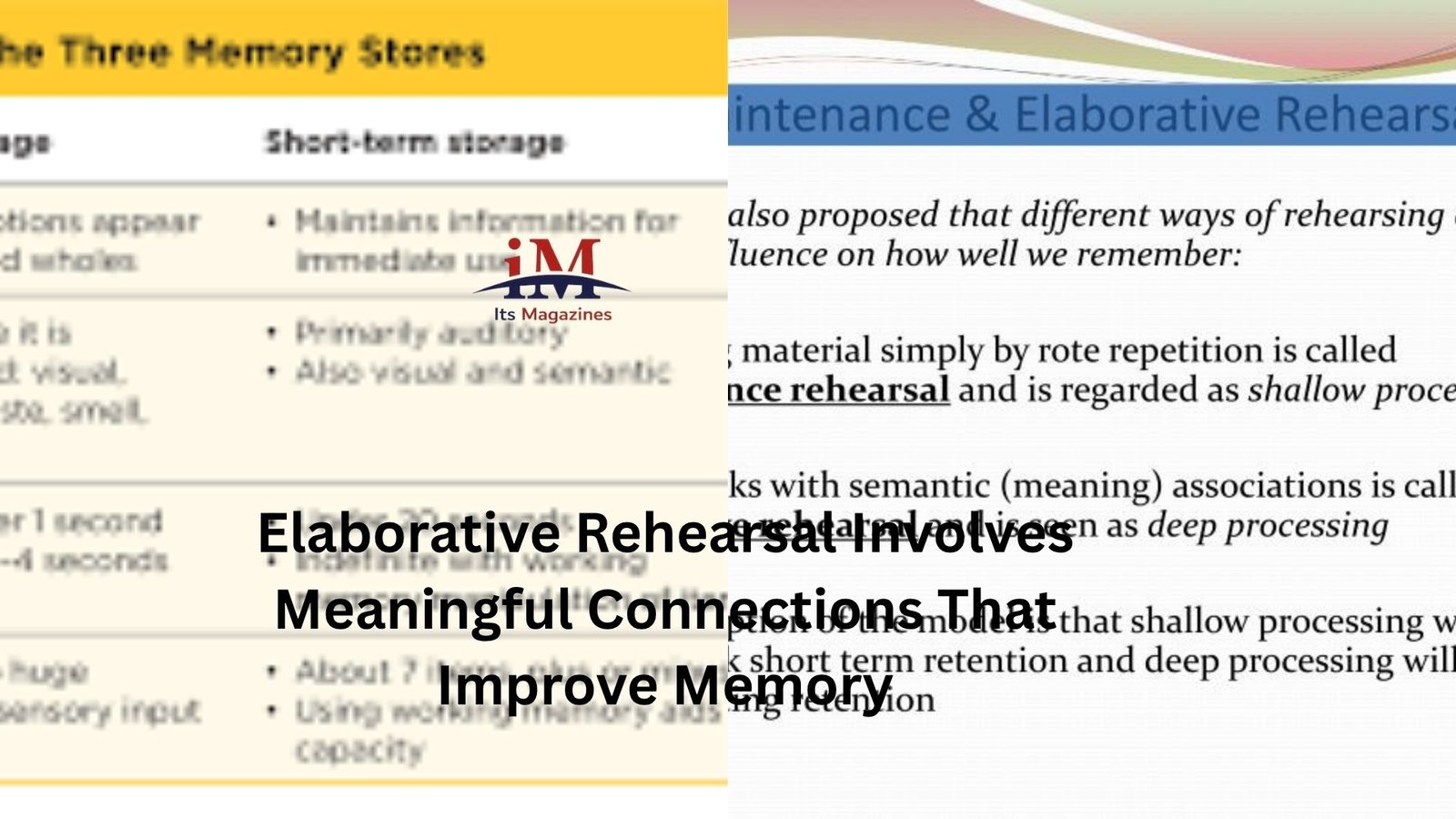
When people ask, “elaborative rehearsal involves ________,” the missing idea is usually making meaningful connections between new information and what you already know. Instead of repeating something over and over, you actively think about its meaning, relate it to existing knowledge, and create mental links that make it easier to remember later.
That sounds simple, but it’s one of the most powerful memory techniques people use without even realizing it.
The Difference Between Repeating and Understanding
Think about trying to remember a phone number.
You could repeat it ten times in your head. That’s one approach.
Or you could notice that part of the number matches your birthday, another part resembles your old address, and the last few digits remind you of a sports jersey number you know well.
Suddenly the number isn’t just a random string anymore.
That’s the core idea behind elaborative rehearsal.
Simple repetition is often called maintenance rehearsal. You’re keeping information active for a short time. It may help you remember something briefly, but it doesn’t always create a lasting memory.
Elaborative rehearsal works differently. You’re adding meaning. You’re connecting. You’re building a mental network around the information.
And our brains tend to hold onto meaningful information far better than isolated facts.
Why Connections Matter So Much
Memory isn’t like a filing cabinet where every fact gets placed into its own neat folder.
It’s closer to a web.
Every idea links to other ideas. Every experience connects to previous experiences. The more connections you create, the more pathways lead back to that memory.
Imagine meeting someone named Rose.
You might remember her more easily if you think about roses in a garden, a relative with the same name, or a favorite song that mentions roses.
Now the name has multiple hooks attached to it.
Later, any one of those hooks might help pull the memory back into awareness.
That’s one reason elaborative rehearsal is so effective. It gives information more than one route back into your memory.
What Elaborative Rehearsal Actually Looks Like
People sometimes assume memory strategies have to be complicated.
Not really.
Elaborative rehearsal often happens through simple mental habits.
You read a new concept and ask yourself what it means.
You compare it with something you already understand.
You create an example.
You imagine using the information in a real situation.
You explain it in your own words.
Let’s say you’re learning about photosynthesis.
Instead of memorizing a textbook definition, you might picture a plant acting like a tiny solar-powered food factory. You connect sunlight, leaves, energy, and growth into a meaningful image.
That extra thinking creates stronger memory traces.
The information becomes part of something larger rather than remaining an isolated fact.
The Power of Personal Examples
Here’s something many students discover by accident.
Facts become easier to remember when they relate them to their own lives.
Suppose you’re learning about supply and demand in economics.
The definition may feel abstract at first.
Then you remember trying to buy concert tickets for a popular artist. Thousands of people wanted a limited number of seats, and prices climbed rapidly.
Now the concept has a personal story attached to it.
That story becomes a memory anchor.
The same principle works outside classrooms.
Learning a new person’s name? Connect it to someone you know.
Trying to remember a historical event? Relate it to something happening in today’s world.
Need to understand a business principle? Find an example from your own job.
Personal relevance gives information weight.
And information with weight tends to stick.
Why Asking Questions Helps
One of the easiest ways to use elaborative rehearsal is to become curious.
Instead of accepting information at face value, ask questions about it.
Why does this matter?
How does it work?
What does it remind me of?
When would I use this?
How is it different from something similar?
These questions force your brain to interact with the information instead of simply receiving it.
Passive exposure rarely creates strong memories.
Active engagement often does.
Think about conversations you remember years later. Usually they weren’t memorable because you heard words. They were memorable because you thought about them, reacted to them, questioned them, or connected them to something meaningful.
Learning works in much the same way.
The Role of Understanding
Let’s be honest.
Many people try to memorize information before they understand it.
That’s usually the hard way.
Understanding naturally supports memory because meaning creates structure.
Imagine trying to remember random puzzle pieces scattered across a table.
Now imagine assembling those pieces into a complete picture.
The second task is easier because the pieces now fit together.
Elaborative rehearsal helps build that picture.
Rather than storing disconnected facts, you’re creating relationships between ideas.
As those relationships grow, remembering becomes less about effort and more about recognition.
You see one piece and the others often follow.
Everyday Situations Where It Works
This isn’t just a study technique.
People use elaborative rehearsal constantly in everyday life.
A parent remembers a teacher’s name by linking it to a childhood friend.
A traveler learns a few foreign-language words by connecting them to familiar sounds.
A new employee remembers company procedures by relating them to previous jobs.
A cook learns a recipe by understanding why ingredients work together instead of blindly memorizing steps.
The pattern stays the same.
New information gets connected to existing knowledge.
Those connections strengthen memory.
Once you start noticing it, you’ll see the process everywhere.
Why Some Memories Fade Anyway
Even meaningful learning doesn’t guarantee perfect recall.
Time matters.
Practice matters.
Attention matters.
You can create strong connections and still forget details later if you never revisit the information.
The good news is that elaborative rehearsal often makes review much easier.
Instead of relearning everything from scratch, you’re reactivating an existing network of connections.
It’s similar to walking a trail through the woods.
The first trip takes effort.
Each return trip makes the path easier to follow.
That’s why meaningful learning tends to feel more durable than rote memorization.
The foundation is already there.
Turning Information Into Stories
Stories deserve special attention because they’re naturally connected structures.
Humans tend to remember stories remarkably well.
A list of unrelated facts may disappear quickly.
A narrative often stays.
Suppose you need to remember several concepts from a lesson.
Rather than treating them as separate items, you could imagine them interacting within a scenario.
Many people do this instinctively.
They create mini stories, visual scenes, or personal examples that tie information together.
The brain often responds well to this approach because stories provide context, emotion, and relationships between ideas.
Those are exactly the elements elaborative rehearsal relies on.
Common Mistakes People Make
One mistake is confusing familiarity with learning.
Reading the same paragraph five times can make it feel familiar.
That doesn’t necessarily mean you’ll remember it later.
Another mistake is highlighting large sections of text without thinking deeply about what they mean.
Recognition is not the same as recall.
Elaborative rehearsal requires engagement.
You have to do something with the information.
Connect it.
Question it.
Apply it.
Translate it into your own words.
The mental effort involved is actually part of what makes the memory stronger.
Oddly enough, learning often improves when it feels slightly challenging.
Making Elaborative Rehearsal a Habit
You don’t need a special system.
Small changes can make a big difference.
When you learn something new, pause for a moment.
Ask yourself what it reminds you of.
Think about where you’ve seen the idea before.
Create an example from your own experience.
Explain it as if you’re teaching a friend.
Even a minute of meaningful reflection can be more valuable than several minutes of mindless repetition.
Over time, these habits become automatic.
You start looking for connections naturally.
And learning becomes less about memorizing information and more about integrating it into what you already know.
The Real Meaning Behind the Blank
When people encounter the statement “elaborative rehearsal involves ________,” the best completion is usually something along the lines of forming meaningful associations between new information and existing knowledge.
That definition may sound straightforward, but its impact is enormous.
Memory improves when information has meaning.
Meaning grows through connections.
The more ways you connect an idea to things you already understand, the more likely that idea is to stay available when you need it.
Whether you’re studying for an exam, learning a skill, remembering names, or simply trying to retain useful information, the principle remains the same.
Don’t just repeat information.
Work with it.
Connect it.
Make it part of something larger.
That’s where lasting memory often begins.